
Maxwell Publications
European Heart Rhythm Association 2026 Abstracts
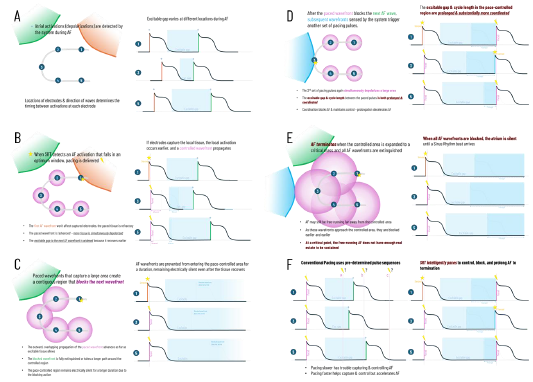
Our team presented two posters at the European Heart Rhythm Association (EHRA) annual congress in Paris, France, highlighting our progress in developing a next-generation alternative to catheter ablation for atrial fibrillation.
Left atrial multi-site pacing achieves up to 10x greater AF cycle length prolongation vs. catheter ablation.
Published: 2026
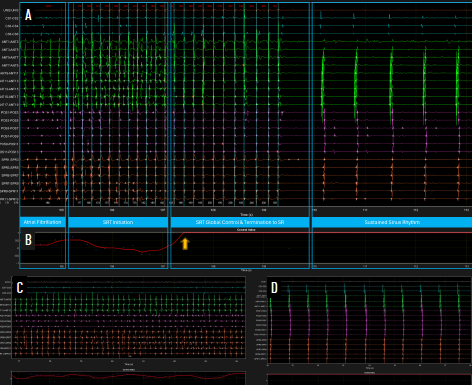
Real-Time Global Control Index for adaptive Atrial Resynchronization: A Quantitative Mechanism for Novel AF Therapy.
Published: 2026
Heart Rhythm Society 2026 Abstract
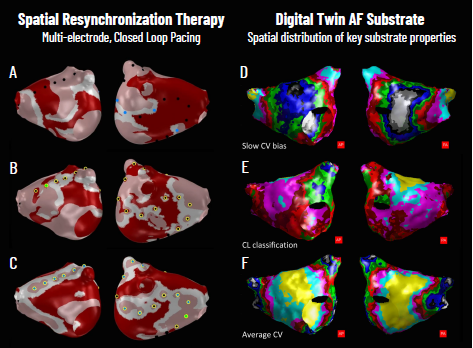
Closed-loop Adaptive Pacing Outperforms Programmed Sequences for AF Termination.
Atrial fibrillation affects more than 37 million people worldwide and remains a leading cause of stroke, heart failure, and cardiovascular morbidity. While rhythm control has demonstrated superiority over rate control, achieving acute AF termination without high-energy shock remains an unmet clinical need.
The following work was accepted for poster presentation at the Heart Rhythm Society (HRS) 2026 Annual Scientific Sessions in Chicago, IL, comparing AF termination efficacy of the closed-loop SRT adaptive algorithm versus a fixed programmed pulse sequence across patient-derived persistent AF substrates.
Published: 2026
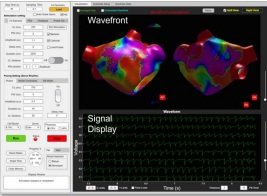
Physiologic, Realistic, Computer Modeling of Atrial Fibrillation to Facilitate the Development and Testing of Treatment Strategies
An interactive, physiologically realistic (PR), and accurate computer simulation allows multiple scenarios to be tested in a “live” environment and has become a key step in the rapid development and testing of treatment strategies for atrial fibrillation (AF). Develop an accurate model of AF that allows the user to define the regions and zones of anisotropic conduction to test the effectiveness of a variety of AF treatment strategies.
Heart Rhythm Society Abstract
Published: 2022
Synchronized Biventricular Heart Pacing in a Closed-Chest Porcine Model Based on Wirelessly Powered Leadless Pacemakers
Scientific Reports: Nature Research
About 30% of patients with impaired cardiac function have ventricular desynchrony and seek cardiac resynchronization therapy (CRT). In this study, we demonstrate synchronized biventricular (BiV) pacing in a leadless fashion by implementing miniaturized and wirelessly powered pacemakers.

Published: 2020
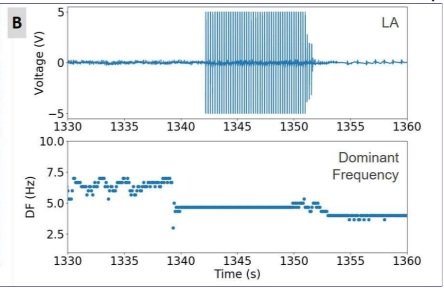
Imperceptible Defibrillation of Atrial Fibrillation Using Low-Power, Multi-Site Pacing
New advancements in pacemaker technology have pushed the field from traditional pacemakers to leadless pacemakers to mitigate risks. While current leadless pacemakers reduce the risks associated with leads, they have not been able to substantially reduce the size and weight of these pacemakers, limiting their ability to pace from multiple chambers. This proof-of-concept study shows our wirelessly powered microchip can pace the ventricular myocardium and demonstrates potential for these kinds of devices.
Heart Rhythm Society Abstract
Published: 2019
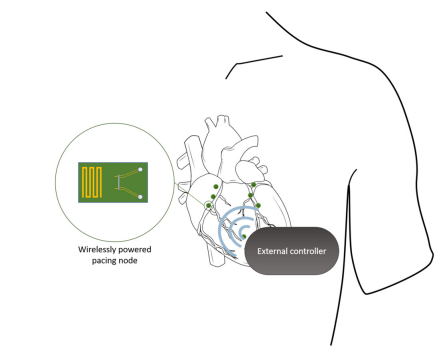
Leadless multisite pacing: A feasibility Study using Wireless Power Transfer Based on Langendorff Rodent Heart Models
Fifteen to thirty percent of patients with impaired cardiac function
have ventricular desynchrony and warrant cardiac resynchronization therapy (CRT). While leadless pacemakers eliminate lead‐related complications, their current form factor is limited to single‐chamber pacing. In this study, we demonstrate the feasibility of multisite, simultaneous pacing using miniaturized pacing nodes powered through wireless power transfer (WPT).
Journal of Cardiovascular Electrophysiology
Published: 2018
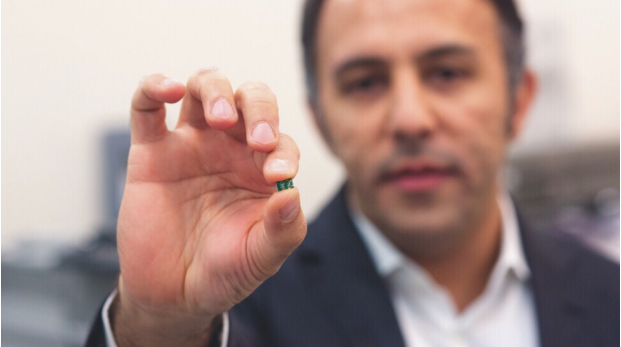
Novel Wirelessly Powered Epicardial Microchip Pacemaker
New advancements in pacemaker technology have pushed the field from traditional pacemakers to leadless pacemakers to mitigate risks. While current leadless pacemakers reduce the risks associated with leads, they have not been able to substantially reduce the size and weight of these pacemakers, limiting their ability to pace from multiple chambers. This proof-of-concept study shows our wirelessly powered microchip can pace the ventricular myocardium and demonstrates potential for these kinds of devices.
Heart Rhythm Society Abstract
Published: 2017